
What Is the Best Pillow for Side Sleepers?
The best pillow for side sleepers is tall and firm enough to fill the space between your ear and the outside of your shoulder. That keeps your head level with your spine all night. Broader shoulders need more height, and a soft mattress that lets the shoulder sink needs a little less. Firmness matters because a pillow that starts at the right height but sinks under your head ends up too low. A bolster or pillow between the knees stops the top leg dropping forward and twisting the hips.
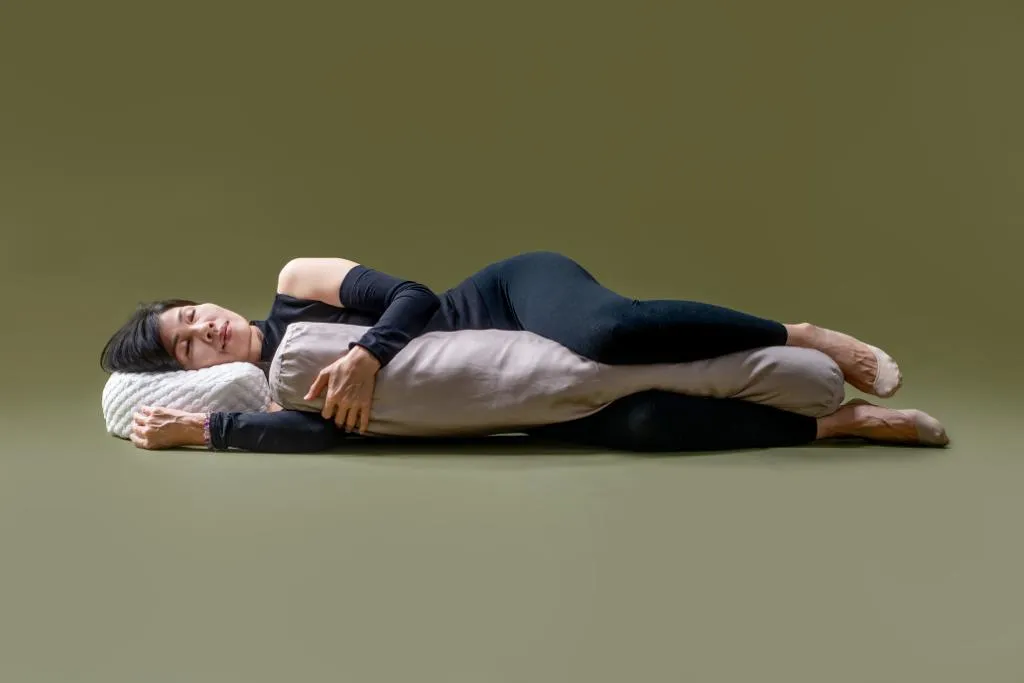
Side sleepers often wake with a sore shoulder, a numb arm, or a neck that complains at the first turn of the head. When that happens night after night, the pillow is one of the first things worth checking.
This guide covers pillow height and firmness for side sleepers, knee and arm support, ear comfort, and sleeping in more than one position. Back and stomach sleepers get a short section each. It is part of our guide to choosing the best pillow in Singapore.
What does a side sleeper's pillow need to do?
A side sleeper's pillow has to fill the gap that your shoulder creates between your head and the mattress. Done right, your head neither tips down towards the mattress nor is propped up towards the ceiling.
Adults spend more of the night on their side than in any other position. In one study using body-worn sensors, people spent about 54% of their time in bed on their side. It is also the position that asks most of a pillow, because the shoulder holds your upper body off the bed.
A quick check: lie on your side and ask someone to look at you from the foot of the bed. Your nose should line up with the centre of your chest, along a line parallel to the mattress.
How high should a pillow be for side sleeping?
A side sleeper's pillow should be about as high as the distance from the side of your neck to the edge of your shoulder. Subtract however far your shoulder sinks into the mattress. That is why shoulder width matters more than any general size.
| Factor | You need more height if… | You need less height if… |
|---|---|---|
| Shoulder width | Your shoulders are broad | Your shoulders are narrow |
| Mattress | It is firm, so your shoulder stays up | It is soft, so your shoulder sinks in |
| Filling | It is soft and compresses under your head | It is firm and keeps its shape |
A pillow is too low if you slide an arm under it, fold it in half, or wake with your head tipped down. If your head is tilted up and the side of your neck feels stretched, the pillow is too high.
A 2021 review found that research has not yet pinned down an ideal pillow height. It lists body size among the factors that decide it. At Mpillow, the length of your shoulders sets the pillow's height. The Premium configurator also measures your neck length, and how far your neck and head sit from your upper back, to fine-tune the contour.
How firm should a side sleeper's pillow be?
A side sleeper's pillow should be medium-firm to firm, so that it holds its height under the weight of your head all night. The surface can still feel soft.
Fillings that hold height well include latex, foam, buckwheat, and fibre packed into separate compartments or pouches. Loose polyester and down compress the most, so they suit side sleepers least. In a 2010 trial of side sleepers, latex pillows did best against waking headache and arm pain, and a feather pillow did worst.
A pillow that has gone flat is simply too low. Our guide to when to replace your pillow covers the signs.
The Mpillow mixes softer hollow-fibre pouches with firmer fibre-ball pouches to set both height and feel. The Basic Mpillow is the softer of the two tiers, and Premium firmness is set to your preference.
What should side sleepers do with their knees, arms and shoulders?
Support your top leg and top arm, so that your body does not roll forward. A pillow or bolster between the knees stops the top leg dropping across, which keeps the hips and lower back level. Mayo Clinic suggests drawing your legs up slightly with a pillow between them.
- Knees: bend them slightly and keep a pillow, or the lower end of a bolster, between them.
- Top arm: hug a bolster or pillow, so the top shoulder does not roll forward and down.
- Lower arm: keep it in front of you rather than trapped under the pillow.
- A sore shoulder: try sleeping on the other side. In a 2012 study of people with pain in one shoulder, most of those who slept on one side lay on the painful shoulder.
Many Singapore households already sleep hugging a bolster, which does both the knee and arm jobs at once. The Mbolster is built on the same modular structure as the Mpillow. The pillow supports your neck and the bolster supports your torso, for hip-to-spine support on your side. Our guide to choosing a bolster covers lengths and fillings, and the Mbolster configurator recommends a length from your height.
Why does your ear hurt when you sleep on your side?
Your ear is pressed between your head and the pillow, so a firm, high pillow can push on it for hours. A pillow at the right height spreads the weight across the side of your head, and a softer top layer eases the pressure.
The Premium Mpillow configurator asks whether you get ear discomfort when sleeping on your side, alongside your measurements. Mpillow also offers an Ear Comfort Pad.
If an ear stays sore after you change your pillow, see a doctor. Get a tender lump on the ear's rim checked, especially if lying on it hurts. This kind of lump can look like a skin cancer, so it needs a doctor's assessment (StatPearls).
Which side should you sleep on?
Either side can work, but acid reflux and pregnancy change the advice. In people with reflux, sleeping on the left side is linked with less night-time acid exposure than sleeping on the right (a 2023 meta-analysis).
From the second trimester of pregnancy, ACOG says sleeping on your side may be best. Lying on your back can press on a major blood vessel that supplies the uterus. Our guide to pregnancy bolster pillows covers support for the bump, hips and back.
What if you sleep on your side and your back?
Combination sleepers need two heights in one pillow: lower in the middle for back sleeping, and higher at the edges for side sleeping. One even height will be too low when you are on your side, or too high when you are on your back.
An adjustable pillow set to a compromise height partly suits both. A zoned pillow gives each position its own height, so you can roll over without rearranging the pillow. If you are weighing these options against a standard pillow, see our comparison of ergonomic and regular pillows.
The Mpillow is built for this. Its M shape has a centre zone for back sleeping, and left and right zones at different heights for side sleeping. "Side and back" is one of the sleeper types the configurator asks you to choose from.
What pillow do back sleepers need?
Back sleepers need a medium-height pillow that fills the hollow behind the neck without pushing the head forward. Harvard Health suggests a rounded pillow under the curve of your neck, with a flatter one cushioning your head.
- Too high: your chin is pushed towards your chest.
- Too low: your head tips back and your chin points upwards.
- Lower back: Mpillow's own advice is that back sleepers may also need lower-back support. A pillow under the knees is one way to give it. Mayo Clinic says this may help keep the natural curve of your lower back.
If you snore, the NHS suggests sleeping on your side. See a doctor if you gasp or choke in your sleep, or feel sleepy during the day. The NHS lists these as reasons to see a GP, as they can be signs of sleep apnoea.
What pillow do stomach sleepers need?
Stomach sleepers need the thinnest, softest pillow they can manage, or none. Face down, you have to turn your head fully to one side to breathe. HealthHub Singapore says this puts a lot of strain on your neck. A thick pillow tilts it back as well.
Mpillow recommends that stomach sleepers try moving to side sleeping. If you stay on your front, Mayo Clinic suggests a pillow under your hips and lower stomach to ease strain on your back. Our guide to using a bolster for better sleep covers stomach sleeping in more detail.
When should a side sleeper see a doctor or physiotherapist?
See a doctor or physiotherapist if neck or shoulder pain lasts more than a few weeks or keeps coming back. Do the same after an injury, or if you have numbness, tingling or weakness in your arm or hand. The NHS advises seeing a GP if neck pain has not gone after a few weeks, or comes with pins and needles. A better pillow can reduce strain at night, but it cannot heal an injury or free a trapped nerve.
Our guide to the best pillow for neck pain explains when the pillow is, and is not, the likely cause. For pillow types and fillings for every position, see our guide to choosing the best pillow in Singapore.
Frequently asked questions
How high should a pillow be for a side sleeper?
High enough to fill the space between your ear and the outside of your shoulder, so your head stays level with your spine. Broader shoulders and firmer mattresses need more height.
Should side sleepers use a firm or soft pillow?
Medium-firm to firm, so the pillow keeps its height under your head all night. A soft surface layer is fine, as long as the pillow underneath does not collapse.
Is memory foam good for side sleepers?
A memory foam pillow holds its height well, but a solid block comes in one fixed height and can feel warm. It suits a side sleeper only if that height matches their shoulders.
Is it better to sleep on your left or right side?
Either side suits most people. If you have acid reflux, sleeping on your left side is linked with less night-time reflux than sleeping on your right.
Can one pillow work for side and back sleeping?
Yes, if it gives two heights: higher at the edges for side sleeping and lower in the centre for back sleeping. The Mpillow's M shape is designed this way.
Why does my ear hurt when I sleep on my side?
Your ear is pressed between your head and the pillow, often for hours. A pillow at the right height with a softer surface spreads the pressure. See a doctor if the ear stays sore or you find a tender lump.
Next step
Start the Premium configurator to have your pillow's side zones set from four measurements and your answers about how you sleep.